
Story
Felder's Framework of Vines
Page A6 Thursday, March 6, 2025 MAGNOLIA GAZETTE Not to put too fine a point on this, but vines need sunshine. They are simply plants with long, thin stems, and in nature they wrap or cling tightly to trees as they...
Page A6 Thursday, March 6, 2025 MAGNOLIA GAZETTE
Not to put too fine a point on this, but vines need sunshine. They are simply plants with long, thin stems, and in nature they wrap or cling tightly to trees as they clamber towards the light. But when tamed and brought into gardens they usually need our help to soar. Taking advantage of a warm winter day, I just stuck new pea sticks between newlyemerging English pea seedlings, adding another of several kinds of vine supports in my garden. I will be sure to pull up bamboo stakes at the end of the season lest they root and take over the garden. Oh, and because I garden for all the senses, to get a tad more pleasure from my pea sticks I spray painted them red, because…well, just because.
While tomatoes have to be tied to stakes, pea vines and their clingy tendrils twine around supports in a hormonal response called thigmotropism, which means “toward touch.” When they touch something, those cells stop growing as quickly as those on the opposite side, which curls the vines inward. (And no, they don’t coil different directions north or south of the equator.)
But back to the supports themselves, which are referred to by almost as many different words as there are types, including simple stakes for tomatoes and peas, strong wires strung between posts for training muscadine grapes, stick teepees and more ornate tuteurs and obelisks, lattice or wires attached to walls for espaliering fruits or ornamental shrubs, and large vine-shaded arbors for sitting beneath.
Not that it makes a huge difference to home gardeners, architects and horticulturists use very specific terms. Generally, an arbor is a semi-open seating area made of upright posts or pillars with either a roof or strong connecting beams overhead and sometimes wood or wire lattice on the sides. An arbor connected to a house or patio or used to create a long, shaded walkway is called a pergola; a standalone arbor with an added domed or pyramidal top is an obelisk.
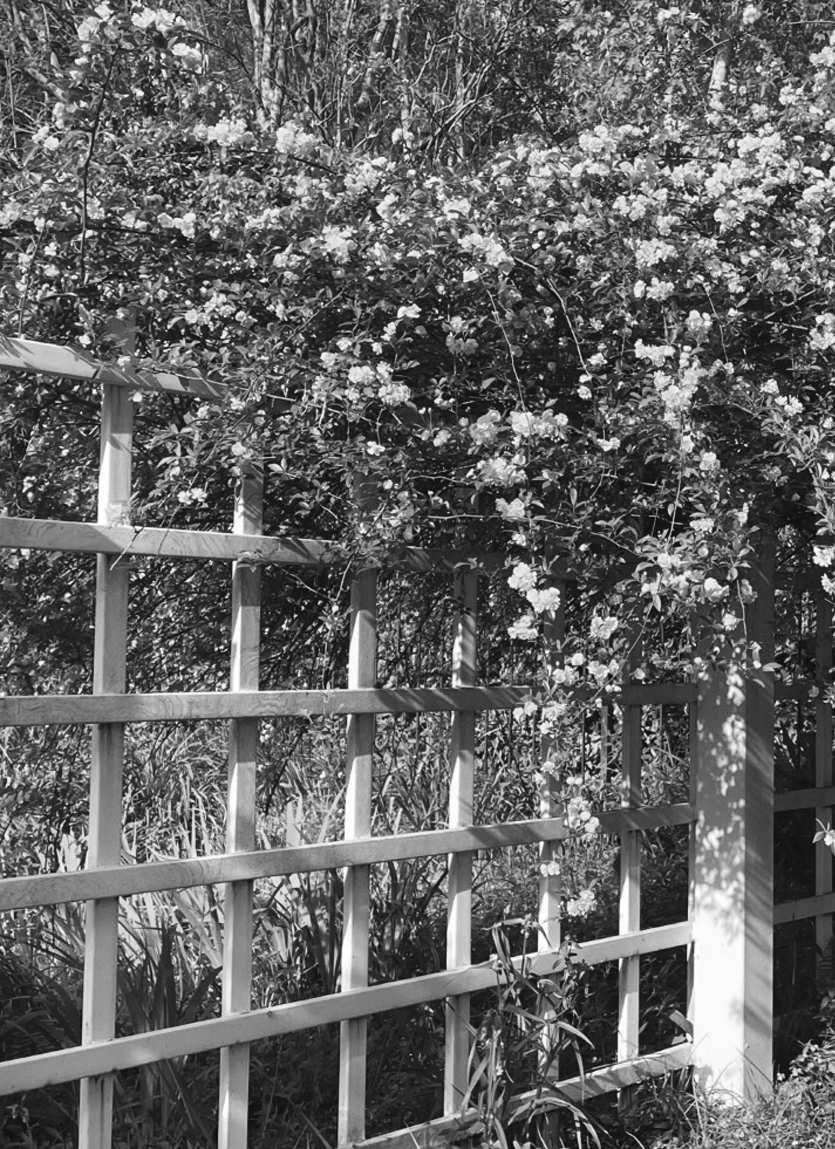
A trellis, on the other hand, can be any variation of open, walllike, often-latticed frame used to partition an area or flat against a wall for supporting vines. When used around patios, pools, or between houses they are called baffles, which thwart prying eyes from neighbors, without being a solid fence. Cheaper than living hedges, a baffle provides instant privacy and can be toned down with a vine or two. Here’s where it gets fun. While a simple post can support a vine, when several wood or metal stakes are combined they become an architectural feature as well; when straight up and topped with something ornate they are obelisks; if they come together in a point, like a narrow pyramid, they are called tuteurs.
Biggest mistake I see with vine supports is their not being tall or sturdy enough. For vigorous, heavy vines like Peggy Martin roses or wisteria, both of which can easily crush a tuteur, I go with tall, sturdy stand-alone posts called pillars. For both my and my son’s landscapes which feature round patios and decks, I scattered a semicircle of heavy pillars made of imposing 4x6 or 6x6 treated posts, twelve feet long so they stand ten feet above the ground. Each has short ornamental “wings” at the tops and all are connected with sturdy half-inch rebar rods for draping vines.
Both for practical vine support and as a hallmark of good garden design, I use all these types of vertical structures in my garden, from simple twig teepees to seating arbors and ornate pillars. Now bring on the vines! FELDER’S FRAMEWORK OF VINES