
Story
Felder's Funky Blooms
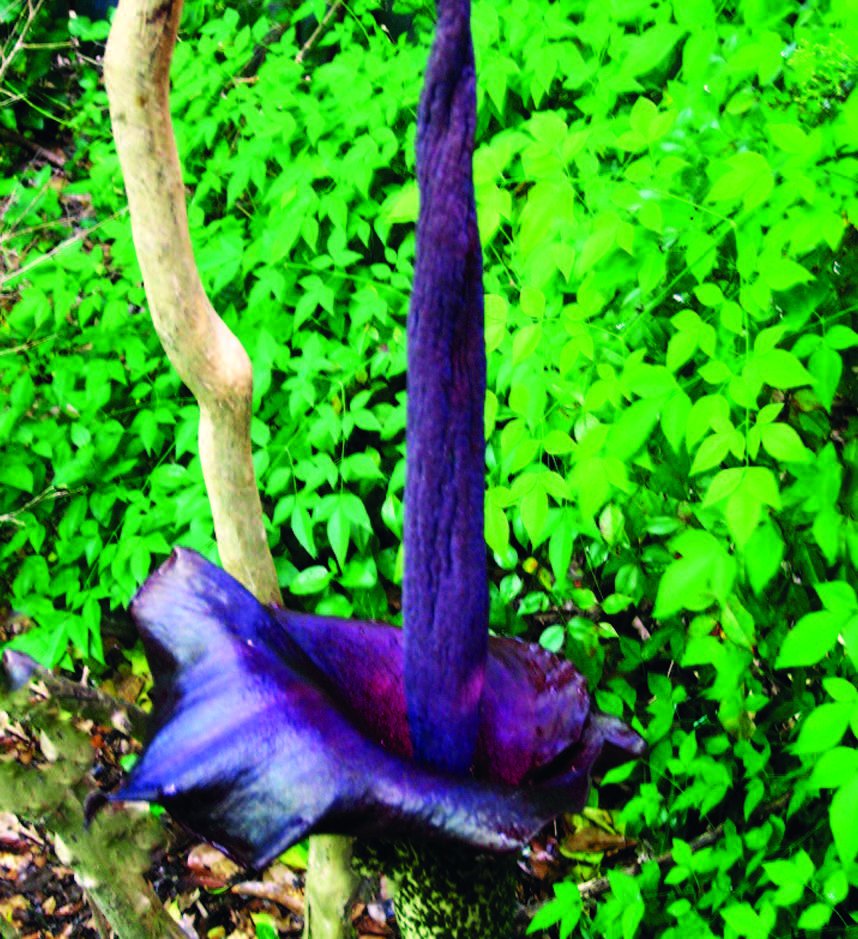
My nose alerted me the other morning that, at last, my voodoo lily had come into its fetid splendor. It, along with a handful of other more celebrated garden plants, has one of the most unusual flower types you will...
My nose alerted me the other morning that, at last, my voodoo lily had come into its fetid splendor. It, along with a handful of other more celebrated garden plants, has one of the most unusual flower types you will find anywhere, but with a twist.
Also called devil's tongue, this tropical corm (Amorphophallus konjac) grows well throughout Mississippi, for folks who seek it out. Needs shade and well drained woodsy soil and lasts for just a few weeks at most. But its single intricately divided leaf, three feet tall and two feet wide, is followed, some years, by the most unusual flower I grow.
The years it flowers, it is party worthy. The large but short-lived flower is weirdly formed, with a fleshy stem, upright leaflike spathe, and long narrow flower spike; think "cupped hand with a finger sticking out of the palm" and you sorta have it pictured. This particular one displays unworldly shades of brown, burgundy, and olive green.
Because, like the popular starfish cactus (Stapelia), it requires flies for pollination, instead of being pretty it smells terrible. Think carrion. Fetid from halfway across the yard.
The only living thing I can compare its, er, bouquet to is the common "stink horn" fungus that rears its version of a mushroom from old mulch every spring and fall. Though harmless and temporary, it can be alarming in both looks and odor.
The voodoo lily flowers die down pretty quickly, though the huge leaf can last for many weeks and returns every spring. I got my gladiolus-like voodoo lily corm as a passalong plant, but my daughter found it and several interesting relatives online.
There are several other commonly grown plants with spathe flowers. Just the Latin name of the popular potted peace lily (Spathiphyllum) gives you a clue to its flower shape. Others include caladiums, Anthurium, painted arum, calla lily, and our native woodland wildflower called Jack in the pulpit and its relatives. Some gardeners also notice the spathe flowers on elephant ears, and potted Chinese evergreen and philodendrons.
But one of the most amazing plants on earth, which flowers so infrequently people often travel from several states away to experience, is related to the voodoo lily. For good reason, which I won't get into, the titan arum (Amorphophallus titanum) is most commonly called corpse flower. The tropical bulb, which can weigh well over two hundred pounds, can be grown in a relatively small pot but takes years to reach flowering maturity.
When it does produce what is known as the world's largest flower, it is stunning, in size and sight (think Audrey in Little Shop of Horrors) and smell.
My teenage daughter Zoe and I were invited to a North Carolina botanic garden party held to watch one unfurl, which happens overnight. The nearly eight-foot-tall flower opened its red spathe to over four feet across, and in the enclosed greenhouse its smell was actually overwhelming (I have photos of some visitors during the episode).
After the experience, I don't my relationship with the then-impressionable Zoe could ever be the same.
Of course, this isn't the only weird flower in the garden enjoyed by folks with alternate visions of beauty. I am thinking potted orchids, bleeding heart, native passion flower, native pitcher plants (whose flowers attract and kill insects for plant food), bird of paradise, and the famous night blooming cereus, whose short-lived but eye-popping flower has long been a party excuse.
All it takes to appreciate these flowers is to grow the plants, most of which are fairly easy grow. But sometimes not so easy on the nose.